
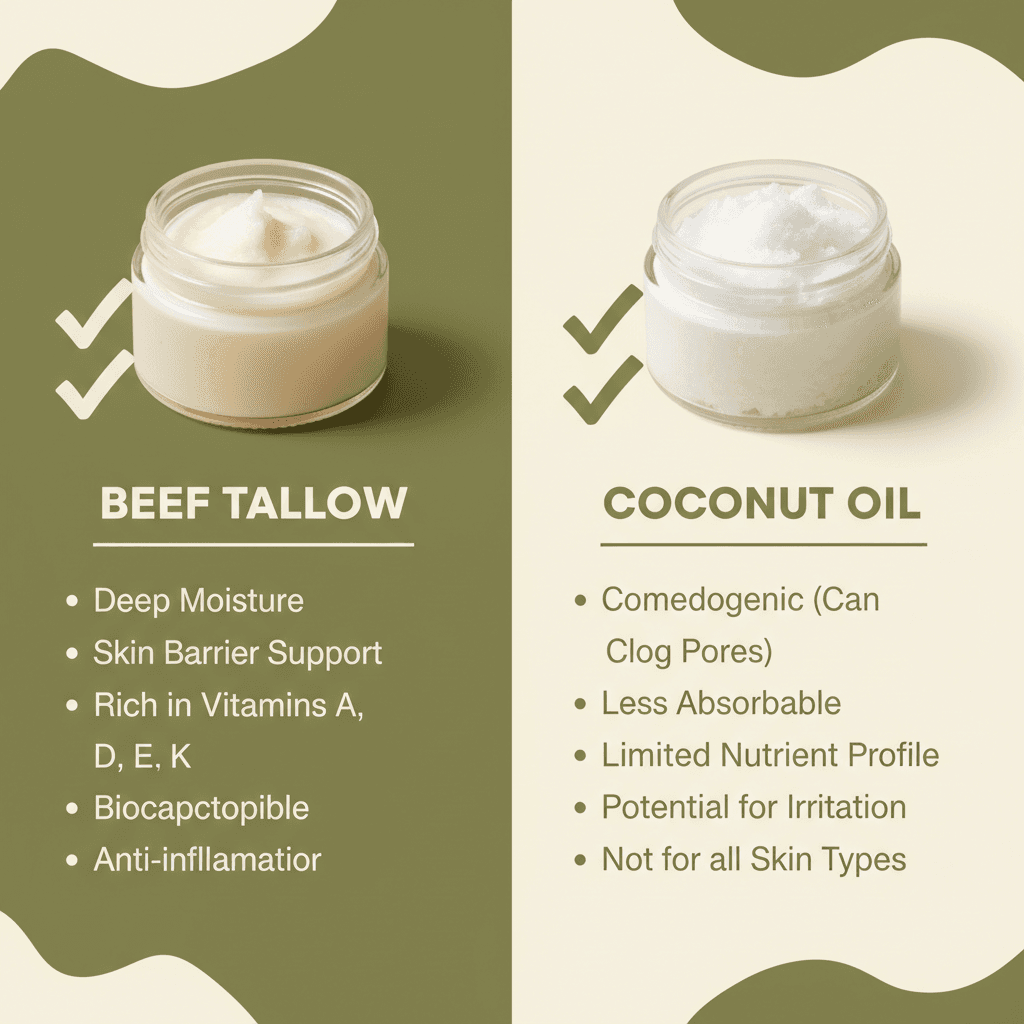
Beef tallow or coconut oil for skincare? We compare fatty acids, comedogenic ratings, absorption, and which works best for your skin type. Full breakdown.
Quick Answer: Beef tallow is generally better for skin than coconut oil for most people. Tallow's fatty acid profile closely mirrors human sebum (~95% similar), its comedogenic rating is lower (2 vs 4), and it delivers more fat-soluble vitamins (A, D, E, K). Coconut oil is better for vegans, body use, hair care, and those who don't mind its higher pore-clogging risk.
If you're diving into the world of natural skincare, you've likely encountered two heavy hitters: beef tallow and coconut oil. Both have devoted followers claiming they're the ultimate moisturiser. But which one actually deserves a spot in your skincare routine?
The debate between beef tallow vs coconut oil for skin isn't just about choosing between animal-based and plant-based products. It's about understanding what your skin truly needs and which ingredient can deliver those results. In this comprehensive comparison, we'll break down the science, benefits, drawbacks, and real-world performance of both.
Quick Comparison: Beef Tallow vs Coconut Oil at a Glance
| Feature | Beef Tallow | Coconut Oil |
|---|---|---|
| Source | Rendered beef fat (grass-fed) | Extracted from coconut flesh |
| Fatty Acid Profile | 50% saturated, rich in oleic acid | 90%+ saturated, mostly lauric acid |
| Comedogenic Rating | 2/5 (low-moderate) | 4/5 (moderately high) |
| Skin Similarity | ~95% similar to human sebum | <50% similar to human sebum |
| Absorption Rate | Fast (penetrates deeply) | Moderate (sits on surface longer) |
| Best for Skin Types | All types, especially dry/sensitive | Normal to dry (avoid if acne-prone) |
| Vitamins | A, D, E, K, B12 | E (limited) |
| Price Point | €25-40 per jar | €10-20 per jar |
| Vegan-Friendly | No | Yes |
What Is Beef Tallow and Why Is It Biocompatible?
Beef tallow is rendered fat from cattle, particularly prized when sourced from grass-fed, pasture-raised animals. For centuries, our ancestors used tallow as their primary moisturiser — not because they lacked alternatives, but because it worked remarkably well.
What makes grass-fed beef tallow exceptional for skincare is its fatty acid profile that nearly mirrors human sebum — the natural oil our skin produces. This biocompatibility means your skin recognises and absorbs tallow as if it were its own moisturising oils.
Irish Grass-Fed Advantage: Irish beef tallow, like that used in TalGlow products, comes from cattle that graze year-round on mineral-rich pastures. This results in higher concentrations of vitamins A and E, plus omega-3 fatty acids, compared to grain-fed alternatives.
What Is Coconut Oil and How Does It Compare?
Coconut oil is extracted from the flesh of mature coconuts and has been a staple in tropical skincare for generations. In recent years, it's experienced a mainstream resurgence as a "miracle" natural beauty product.
Coconut oil's primary claim to fame is its high lauric acid content (about 50%), which has proven antimicrobial and anti-inflammatory properties. This makes it excellent for certain applications — but not ideal for all skin types.
Which Is Better for Dry or Sensitive Skin?
Coconut oil deserves credit here: in a randomised controlled trial of 117 children with atopic dermatitis, eight weeks of virgin coconut oil reduced SCORAD severity scores by 68%, versus 38% for mineral oil. Tallow has no equivalent trial yet — a 2024 scoping review found it promising as a moisturiser but called for controlled studies — so its case rests on biocompatibility rather than trial data.
For dry or sensitive skin, beef tallow is the stronger choice. Its oleic acid content (40-50%) penetrates deeply into the skin's layers, while its similarity to sebum means it's less likely to cause reactions. The barrier-repairing fatty acids (stearic and palmitic acids) help rebuild compromised skin.
Coconut oil tends to sit on top of the skin rather than penetrating deeply, providing surface-level moisture rather than structural repair.
Which Has a Lower Comedogenic Rating — Tallow or Coconut Oil?
Beef tallow scores significantly better here. Its comedogenic rating of 2 out of 5 compares favourably to coconut oil's 4 out of 5. For anyone prone to blocked pores, blackheads, or acne, coconut oil on the face is genuinely risky, while tallow is much less likely to cause problems.
Many dermatologists warn against using coconut oil on the face for this reason.
Which Is Better for Barrier Repair?
Beef tallow wins clearly for barrier repair. The combination of ceramide-like fatty acids (stearic and palmitic acids), cholesterol, and fat-soluble vitamins gives tallow the exact building blocks the skin barrier needs to repair itself. If your barrier is compromised from over-exfoliation, harsh cleansers, or environmental stress, tallow is the better choice.
Coconut oil doesn't contain these structural lipids in the same proportions, so while it can help surface dryness, it doesn't rebuild the barrier from within.
Which Is More Sustainable?
Beef tallow is actually a by-product of the meat industry — it uses an otherwise-wasted resource from cattle already raised for food. When sourced from Irish grass-fed farms, the supply chain is short and the product is traceable.
Large-scale coconut farming has significant environmental impacts, including deforestation and high water usage. From a sustainability standpoint, using a by-product (tallow) is generally more eco-friendly.
Beef Tallow: Pros and Cons
Pros
1. Biomimetic Moisturisation Tallow's similarity to human sebum means it integrates seamlessly with your skin's natural moisture barrier. Rather than sitting on top of your skin, it penetrates deeply to repair and strengthen from within.
2. Rich in Fat-Soluble Vitamins
- Vitamin A: Supports cell turnover and collagen production
- Vitamin D: Anti-inflammatory, helps with skin conditions
- Vitamin E: Powerful antioxidant that protects from free radicals
- Vitamin K: Reduces dark circles and promotes healing
3. Barrier Repair Excellence If you have a damaged moisture barrier, tallow's lipid profile helps rebuild the protective layers of your skin.
4. Lower Comedogenic Rating At 2 out of 5, tallow is significantly less likely to clog pores compared to coconut oil.
5. Long-Lasting Hydration Because tallow penetrates deeply, the hydration lasts longer. Many users report needing less product less frequently.
Cons
1. Not Vegan Tallow is an animal product — a dealbreaker for those following a plant-based lifestyle.
2. Initial Adjustment Period Some users experience a 2-4 week adjustment period as their skin recalibrates oil production.
3. Limited Availability Quality grass-fed tallow isn't in every pharmacy. You'll typically need to order from specialty brands like TalGlow.
4. Higher Price Point Grass-fed sources are more expensive than conventional. Expect to pay €25-40 for a premium jar.
Coconut Oil: Pros and Cons
Pros
1. Vegan and Plant-Based Coconut oil checks the box for those avoiding all animal products.
2. Antimicrobial Powerhouse The high lauric acid content gives coconut oil strong antibacterial and antifungal properties.
3. Pleasant Scent Most people enjoy the natural tropical fragrance of coconut oil.
4. Widely Available and Lower Cost At €10-20 per jar for quality organic coconut oil, it's more budget-friendly and found everywhere.
Cons
1. High Comedogenic Rating With a rating of 4 out of 5, coconut oil is highly likely to clog pores for many people.
2. Surface-Level Hydration Coconut oil tends to sit on top of the skin rather than penetrating deeply. It doesn't repair the underlying barrier as effectively.
3. Not Ideal for Facial Use Many dermatologists warn against using coconut oil on the face, particularly for those prone to acne or blackheads.
Which One Should You Choose?
Choose Beef Tallow If:
- You have dry or dehydrated skin that needs deep, lasting moisture
- Your moisture barrier is damaged from over-exfoliation or harsh products
- You're acne-prone but still need intense hydration
- You want bioavailable vitamins to support skin health
- You have sensitive skin that reacts to many products
- You're dealing with eczema, psoriasis, or rosacea
Choose Coconut Oil If:
- You follow a vegan lifestyle
- You have normal to dry skin with no history of acne
- You're using it primarily on your body (not face)
- You have a fungal or bacterial skin condition
- You want a multi-purpose product for hair, body, and cooking
Can You Use Both Tallow and Coconut Oil?
Yes — many people use both strategically:
For Face: Use beef tallow as your primary facial moisturiser. Use coconut oil occasionally as a cleansing oil.
For Body: Use beef tallow on problem areas (eczema patches, very dry zones). Use coconut oil on the rest of your body for general moisture.
Hair: Coconut oil excels here — tallow is not ideal for hair in most cases.
Frequently Asked Questions
Is beef tallow or coconut oil better for acne-prone skin?
Beef tallow is generally better for acne-prone skin due to its lower comedogenic rating (2 vs 4). Tallow's similarity to human sebum also helps balance oil production rather than clogging pores. However, always patch test first, as individual skin chemistry varies.
Can I use beef tallow if I have oily skin?
Yes. Counter-intuitively, beef tallow can help regulate oily skin. Because it mimics your skin's natural sebum, it can signal to your skin to produce less oil over time. Start with a small amount and give your skin 2-4 weeks to adjust.
Is coconut oil good for anti-ageing?
Coconut oil has limited anti-ageing benefits compared to beef tallow. While it does contain some vitamin E, it lacks vitamins A, D, and K that are proven to support collagen production and skin cell turnover.
How quickly does beef tallow absorb compared to coconut oil?
High-quality beef tallow absorbs faster than coconut oil because of its biomimetic properties. Most users report tallow absorbing within 3-5 minutes, while coconut oil can take 10-15 minutes and may leave a greasy residue.
Which is more environmentally sustainable?
Beef tallow is a by-product of the meat industry, using an otherwise-wasted resource. Coconut oil requires dedicated farming with significant land clearing and water usage. From a sustainability standpoint, using a by-product is generally more eco-friendly.
Will beef tallow make me smell like beef?
High-quality, properly rendered grass-fed tallow has minimal scent. Any slight odour when first applied typically fades within 5-10 minutes. If your tallow has a strong, unpleasant smell, it may be low-quality or improperly rendered.
Can I mix tallow and coconut oil?
Yes — some people blend them in a 3:1 ratio (tallow:coconut) for a slightly lighter texture that still benefits from tallow's biocompatibility. However, this increases the overall comedogenic rating, so it's not recommended for acne-prone skin.
Can I use these oils on my children's skin?
Both can be used on children, but beef tallow is generally gentler and less likely to cause reactions. Always perform a patch test first. For babies under 6 months, consult your GP before introducing any new skincare products.
Conclusion: Tallow Wins for Most Skin Types
After comparing beef tallow vs coconut oil across all dimensions — fatty acid profile, comedogenic rating, absorption, vitamins, and real-world results — beef tallow emerges as the superior choice for most skin types.
Its biomimetic properties, rich vitamin content, lower comedogenic rating, and proven barrier-repair capabilities make it exceptionally effective for everyone from acne-prone teenagers to adults with dry, sensitive skin.
Coconut oil still has its place — particularly for vegans, body care, and those with normal skin who don't experience clogged pores.
Ready to try it? TalGlow's Irish grass-fed beef tallow is made in small batches in Co. Laois — grass-fed tallow whipped with sweet almond oil and a touch of natural essential oil, no synthetic fragrance, no preservatives, free delivery across Ireland. Learn more about the benefits of beef tallow for skin.
Beef tallow contains 4× more CLA (conjugated linoleic acid) per gram than coconut oil, giving it stronger anti-inflammatory properties for skin.
Nutritional composition data
Ready to Experience Irish Grass-Fed Beef Tallow?
Try TalGlow's premium Irish grass-fed beef tallow moisturizer. Your skin deserves the best nature has to offer.
Shop Now →Continue Reading
Beef Tallow Benefits for Skin: The Complete Guide (2026)
For thousands of years, our ancestors used animal fats for skincare — and they didn't have the skin problems we see today. While modern skincare aisles overflow with synthetic creams promising miracle...
Read more →
Beef Tallow for Acne: Does It Help or Make It Worse?
If you have acne-prone skin, the idea of putting animal fat on your face sounds counterintuitive — maybe even alarming. But the science behind why tallow may actually be *better* for acne-prone skin t...
Read more →